
Jewellery Laser Marking Machine: Gold & Silver Hallmarking and Engraving Guide
A jewellery laser marking machine uses a focused laser beam to create permanent logos, purity marks, serial numbers and personalised text on gold and silver without touching the piece. For most jewellery workshops, a fiber laser is the suitable choice, but the right power, rotary attachment and enclosure depend on what you make. This guide explains how it works, how engraving differs from legally regulated hallmarking, and what to check before you buy.
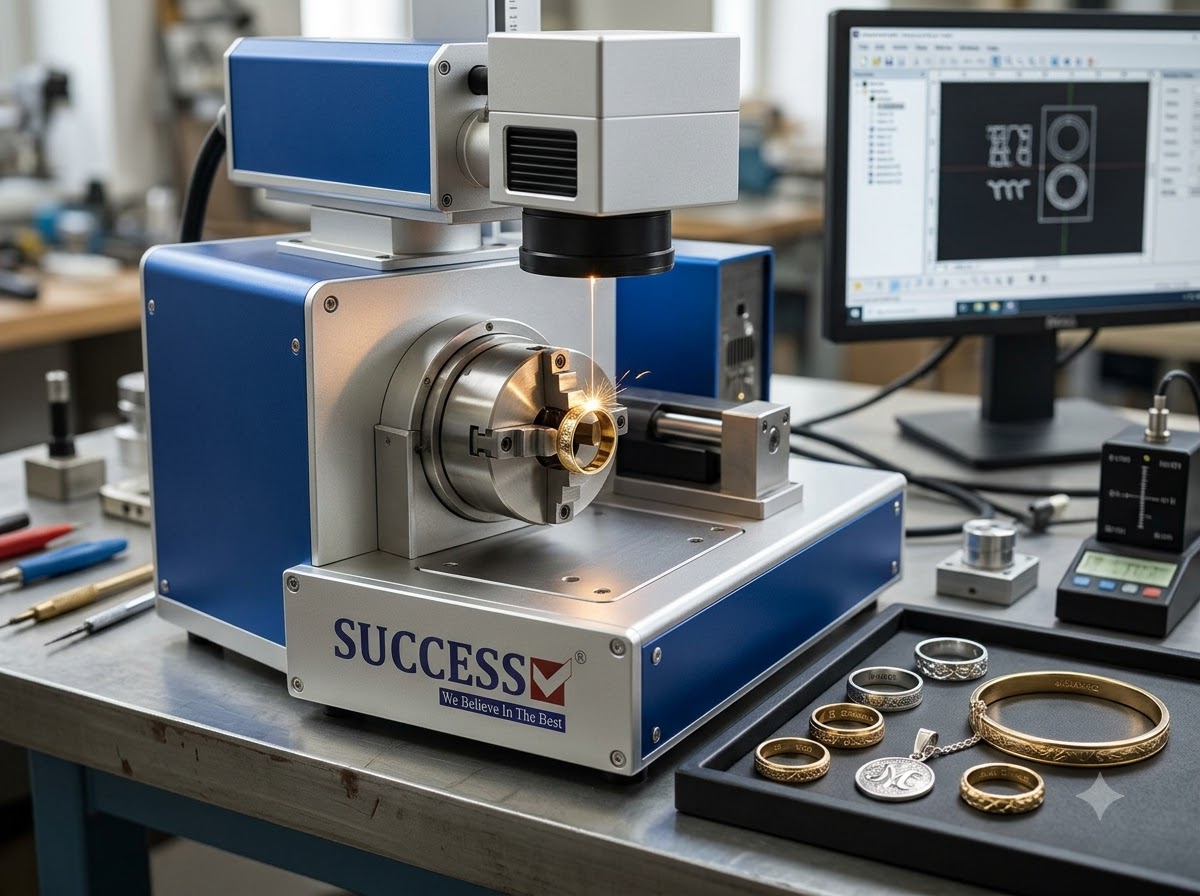
At Success Technologies, we manufacture laser marking and engraving machines in Ahmedabad for Indian industry. Jewellers often ask us the same questions: Which laser suits gold and silver? Can it mark rings and bangles? Does it make a hallmark official? The sections below answer those questions and point out where testing on your own samples matters.
What Is a Jewellery Laser Marking Machine?
A jewellery laser marking machine is a computer-controlled laser system that marks metal surfaces using a very small, precisely positioned beam. A galvo scanner steers the beam across the piece according to a design loaded in the machine software, so text, logos, patterns and codes are reproduced exactly as drawn.
Because the process is non-contact, nothing presses against the jewellery. That reduces the risk of pressure marks or deformation on delicate or thin pieces, a common concern with traditional punch stamping. The machine is used for:
- Brand logos and maker marks on rings, pendants, chains and bangles
- Purity and weight markings as part of in-house identification
- Serial numbers, batch codes and QR or data matrix codes for traceability
- Names, dates and custom messages for personalised gifts
- Fine decorative patterns on suitable surfaces
How Does Laser Marking Work on Gold and Silver?
A fiber laser delivers short pulses of near-infrared light that metals absorb. Each pulse heats a tiny spot on the surface. Depending on the settings, the result can be a light surface mark, a contrast change, or a shallow engraved groove where material is removed.
Four practical points matter in jewellery work:
- Precision: The beam can be focused to a very small spot, which allows fine lines and small characters. The smallest legible text depends on the lens, the metal and the surface.
- Surface finish: Polished, matte, brushed and plated surfaces react differently. The same file can look different on each.
- Marking depth: Depth is controlled by power, speed, frequency and the number of passes. Deeper engraving removes more metal, so check it against your piece weight and tolerance requirements.
- Reflective metals: Gold and silver reflect a lot of light and conduct heat well, so settings often need careful tuning compared with darker or less reflective metals.
Alloy, plating, polish and thickness all change the outcome, which is why a sample marking test on your actual gold and silver pieces is the most reliable way to confirm results before purchase.
Jewellery Hallmarking vs. Laser Engraving
These two terms are often mixed up, but they are different things.
Laser engraving or marking is a manufacturing process. It places a brand, code or personal message on a piece. Any workshop can use it for its own identification purposes.
Hallmarking is a regulated certification of metal purity. In India it is governed by the Bureau of Indian Standards (BIS). Under BIS rules, jewellers register with BIS and send articles to a BIS-recognised Assaying and Hallmarking (A&H) Centre. The centre tests the purity, and the hallmark, including the Hallmark Unique Identification (HUID) code, is applied there after testing.
Owning a laser marking machine does not authorise a business to issue or apply official hallmarks. A machine marking that imitates a BIS hallmark is not a legal hallmark and can create compliance problems. Mandatory hallmarking has been extended in phases across districts and product categories, and the rules have been updated several times, so check the current position on the official BIS website or with a BIS-recognised A&H centre before relying on any regulatory summary, including this one.
Benefits of Laser Marking for Jewellery Manufacturers
- Precision: Small, clean text and detailed logos that are hard to achieve with hand stamping.
- Repeatability: Once a design and settings are saved, the same mark can be reproduced across a batch.
- Branding: A consistent maker mark or logo on every piece supports brand recognition.
- Personalisation: Names, initials and dates can be changed file by file with no tooling change.
- Traceability: Serial numbers and QR or data matrix codes let you link a piece to your own production records.
- Workflow: Digital files replace physical stamps and dies, which makes design changes simpler. Actual speed depends on the mark, the metal and the settings.
Which Laser Marking Machine Is Suitable for Jewellery?
There is no single best configuration. The right choice depends on your products, volumes and required marking depth.
Fiber Laser Marking Machine for Gold and Silver
A fiber laser marking machine is the usual starting point for precious metals because its wavelength is well absorbed by metal, and it produces fine, permanent marks with a compact, air-cooled design in many models. Its limitation is that it is designed for metals and some plastics, not for every material in a jewellery shop. Gemstones, for example, need separate evaluation.
Choosing Between 20W, 30W, 50W and 100W
Higher wattage generally gives more headroom for deeper engraving and faster marking, but more power is not automatically better for fine jewellery.
| Power | Typically suited to | Consider |
|---|---|---|
| 20W | Fine surface marks, small logos, serial numbers | May be slower for deeper engraving |
| 30W | General jewellery marking with light engraving | A common balance of detail and speed |
| 50W | Deeper engraving and higher throughput | Settings need care on thin or delicate pieces |
| 100W | Heavy engraving, bars and thicker items | Often more than fine jewellery needs |
These ranges are general guidance, not guarantees. Laser source type, pulse settings and lens also affect results, so ask for sample marking at the power you plan to buy. Ask whether the source offers adjustable pulse settings, as this can help with fine marking.
Rotary Attachment for Rings and Bangles
A flat table works for pendants, plates and tags. For round items, a rotary laser marking machine setup turns the piece while the laser marks, so text can wrap around a ring band or bangle. Check the diameter range of the rotary, how the piece is held, and whether the fixture can grip your smallest and largest sizes without scratching.
Enclosed vs. Split-Type Laser Marking Machines
An enclosed machine contains the laser inside a protective cabinet, which supports operator safety and suits shops where several people work nearby. A split-type machine separates the laser source from the marking head and offers more flexibility for fixtures and larger setups, but needs proper safety measures such as protective eyewear and controlled access. Whichever you choose, follow the laser safety class guidance supplied with the machine.
When to Consider UV or Other Laser Systems
For gold and silver, fiber is the main option. UV lasers produce less heat in the material and may be considered for heat-sensitive parts such as some gemstones, plastics or packaging, but compatibility must be confirmed by sample testing before you assume they will work. CO2, handheld and conveyor systems are generally designed for other applications and are not a default choice for marking gold and silver jewellery.
Fibre Laser Marking Machine Price in India: What Affects the Cost?
There is no single price for a fiber laser marking machine in India because configurations vary widely. The factors that most affect a quotation are:
- Laser source: Type, brand and pulse capability.
- Power: Higher wattage generally costs more.
- Marking area: Lens and field size.
- Rotary attachment: Needed for rings and bangles, and sized to your products.
- Enclosure: Enclosed cabinet or split-type setup.
- Software: Design features, language support and file compatibility.
- Installation and training: Whether they are included.
- Warranty and after-sales service: Duration, coverage and response process.
Compare quotations on the same configuration, and ask what is included. To get a price for your requirement, request a quotation with your piece types and marking needs.
How to Choose a Laser Marking Machine Manufacturer in India
- Sample marking demonstration: Ask them to mark your own gold and silver samples and review the result under magnification.
- Technical support: Confirm who supports you after installation and how.
- Warranty and spare parts: Ask what is covered, for how long, and how quickly parts are available.
- Training: Your operators should learn software and parameter setting.
- Machine specifications: Get power, source type, marking area, rotary diameter range and safety features in writing.
- Transparent quotation: Each item should be listed, with clear terms for delivery and installation.
Success Technologies has been a laser marking machine manufacturer in Ahmedabad since 2013, and our team can discuss configurations for your jewellery products.
Frequently Asked Questions
Which laser marking machine is suitable for gold and silver jewellery?
A fiber laser marking machine is the most common choice because its wavelength is well absorbed by metals and it produces fine, permanent marks. The right power, marking area and accessories depend on your piece sizes and marking depth, so test on your own samples before buying.
Can a fiber laser marking machine engrave rings and bangles?
Yes, when it is fitted with a rotary attachment. The rotary holds and turns round items so the laser can mark around the curved surface. Confirm the fixture size and diameter range against your products.
What is the difference between laser marking and laser engraving?
Laser marking changes the surface appearance, usually with little or no material removal. Laser engraving removes material to create visible depth. In everyday trade use the terms overlap, and the right setting depends on the design and the item.
How do I choose the right laser power for jewellery marking?
Choose power according to the finest detail you need and the depth and speed you want. Lower-power fiber lasers suit fine surface marks, while higher power helps with deeper engraving and higher throughput. Sample marking on your own gold and silver pieces is the most reliable way to decide.
What factors affect jewellery laser marking machine prices in India?
Price depends on the laser source and brand, power rating, marking area, rotary attachment, enclosure type, software, installation and training, warranty, and after-sales service. Because configurations vary, a written quotation based on your requirement is the accurate way to compare.
Does a laser marking machine automatically make a hallmark legally valid?
No. Owning a laser marking machine does not authorise a business to apply official hallmarks. Official BIS hallmarking in India follows a regulated process involving BIS registration and BIS-recognised Assaying and Hallmarking Centres. Always check current BIS requirements.
Conclusion: Choosing the Right Jewellery Laser Marking Machine
A jewellery laser marking machine gives manufacturers precise, repeatable marking for branding, personalisation and traceability, as long as the configuration fits the jewellery you make and it is not mistaken for an official hallmarking facility. Start by defining your products, mark size and depth, then confirm the result with sample marking on real gold and silver pieces.
If you are evaluating a jewellery laser marking machine for your workshop, explore our fiber laser marking machine and laser engraving machine range, then request a quotation or sample marking demonstration, or message us on WhatsApp.